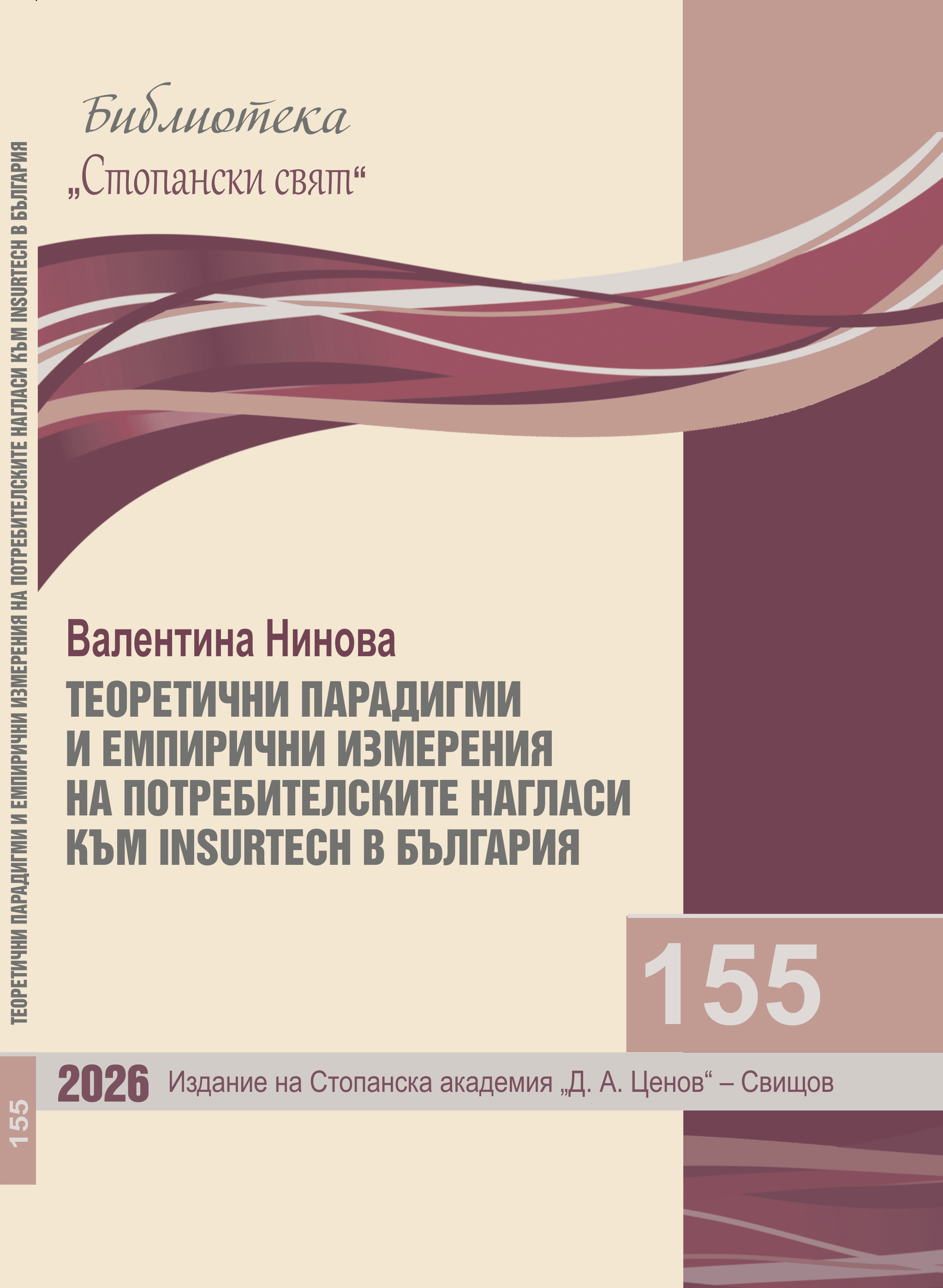
THEORETICAL PARADIGMS AND EMPIRICAL DIMENSIONS OF CONSUMER ATTITUDES TOWARDS INSURTECH IN BULGARIA
ABSTRACT
The insurance industry is undergoing one of its most tangible and significant transformations on a systemic, global, and historical scale. The ongoing paradigm shift in the insurance industry is linked to the adoption of innovative technologies by insurance companies, commonly referred to as 'InsurTech'. This study aims to investigate the essence and specific characteristics of InsurTech (the object of research), as well as the potential and attitudes of individual consumers toward ...
ABSTRACT
The insurance industry is undergoing one of its most tangible and significant transformations on a systemic, global, and historical scale. The ongoing paradigm shift in the insurance industry is linked to the adoption of innovative technologies by insurance companies, commonly referred to as 'InsurTech'. This study aims to investigate the essence and specific characteristics of InsurTech (the object of research), as well as the potential and attitudes of individual consumers toward their adoption within the Bulgarian insurance market (the subject of research). InsurTech innovations are emerging as a critical imperative for the sustainability and competitiveness of the insurance sector in Bulgaria. The study demonstrates that technological transformation is the only effective mechanism to synchronize the growing consumer demands for speed, personalization, and security in insurance services, on the one hand, with the strategic need of companies to optimize costs and resources, on the other. In this sense, InsurTech is not merely an alternative channel, but an irreversible evolutionary process – a fundamental basis for reorganizing business processes and the long-term strategic development of the insurance industry in the country.
TABLE OF CONTENTS
List of figures 7
List of tables 9
List of abbreviations 10
Introduction 11
1. InsurTech between Industry 4.0 and the future of insurance 15
1.1. Literature review 15
1.2. Results and discussion 33
1.3. Summary 37
2. InsurТech: Bibliometric analysis 38
2.1. Materials and methodology for conducting research based on
bibliometric visualization 38
2.2. Results and discussion 42
2.3. Summary 63
3. The InsurTech sector in Bulgaria 65
3.1. InsurТech companies in Bulgaria 65
3.2. Trends in InsurTech financing in Bulgaria 79
3.3. Summary 85
4. Analysis and assessment of the awareness and attitudes of insurance service consumers (individuals) regarding the use of InsurTech in Bulgaria 87
4.1. General information and parameters of the conducted survey 87
4.2. Presentation of results and analysis of the survey responses 90
4.3. Summary 115
Conclusion 118
Cited sources 121
Appendices 139
TOUR OPERATIONS BASED ON INNOVATION:
NEW APPROACHES AND PROSPECTS IN MODERN TOURISM MANAGEMENT
ABSTRACT
This monograph examines the transformation of tour operator activities in the context of digitalization, changing consumer preferences and increased pressure for sustainability of tourism services. The focus is on developing and testing a model for assessing and improving the innovation effectiveness in tourism enterprises performing tour operator activities. The role of technological solutions such as artificial intelligence, big data and digital platforms in personalizing tourism ...
ABSTRACT
This monograph examines the transformation of tour operator activities in the context of digitalization, changing consumer preferences and increased pressure for sustainability of tourism services. The focus is on developing and testing a model for assessing and improving the innovation effectiveness in tourism enterprises performing tour operator activities. The role of technological solutions such as artificial intelligence, big data and digital platforms in personalizing tourism services and increasing the competitiveness of tour operators is analyzed. The research is based on a mixed methodological approach (survey, interviews and regression analysis) and the theoretical basis is supported by established models of innovation adoption and diffusion. The results obtained show that the application of innovations and digital technologies in tour operator activities significantly improves efficiency, enhances service quality, and creates a higher degree of personalization of tourist services. It is established that targeted management of innovation processes is critical for tour operators aiming to strengthen competitiveness and improve market positioning in a dynamic market environment.
CONTENTS
INTRODUCTION 11
CHAPTER I: INNOVATIONS IN TOUR OPERATOR
ACTIVITIES AND MODERN TOURISM MANAGEMENT 17
1.1. Role of tour operators in the tourism industry 17
1.2. Conceptual framework of innovation in tourism management 31
1.2.1. Definition and classification of innovations 31
1.2.2. Digital transformation: AI, Big Data, Blockchain and their
impact on tour operator operations 44
1.3. Innovative approaches in modern tour operations 53
1.4. Innovation-based tour operator model 82
CHAPTER II. INTEGRATED APPROACH TO EVALUATION
OF INNOVATIONS IN TOUR OPERATOR ACTIVITIES 91
2.1. Research design and rationale 91
2.2. Data collection methods for evaluating innovations
in tour operator activities 99
2.3. Theoretical models for innovation adoption 108
2.3.1. Rogers' Diffusion of Innovations (DOI) model 108
2.3.2. Technology Acceptance Model (TAM) 114
2.4. Analytical techniques 123
2.5. Validity, reliability and limitations of the study 137
CHAPTER III: TOUR OPERATIONS BASED ON INNOVATION
BY THE EXAMPLE OF AMAVI TRAVEL LTD 140
3.1. Analysis of the innovation-based tour operator
model in Amavi Travel 142
3.2. Research and evaluation of innovation efficiency
in Amavi Travel 151
3.3. Opportunities for improving innovation strategies in the sector 179
CONCLUSION 189
REFERENCES 192
APPENDICES 223
APPENDIX 1. EMPLOYEE QUESTIONNAIRE 223
APPENDIX 2. USER QUESTIONNAIRE 226
CUSTOMER LIFETIME VALUE
(Conceptual, methodological and applied aspects)
ABSTRACT
This monograph provides a comprehensive theoretical, methodological, and applied examination of Customer Lifetime Value (CLV) as a strategic performance metric and analytical framework in contemporary marketing. It traces the evolution of CLV from its economic and behavioral foundations to modern machine learning and Bayesian modeling approaches. A unified methodological framework is developed, encompassing deterministic, probabilistic, predictive, and hybrid paradigms for CLV ...
ABSTRACT
This monograph provides a comprehensive theoretical, methodological, and applied examination of Customer Lifetime Value (CLV) as a strategic performance metric and analytical framework in contemporary marketing. It traces the evolution of CLV from its economic and behavioral foundations to modern machine learning and Bayesian modeling approaches. A unified methodological framework is developed, encompassing deterministic, probabilistic, predictive, and hybrid paradigms for CLV estimation and forecasting.
The applied section presents working prototypes of models implemented in the R environment – a probabilistic BG/NBD model, ML-based regression and ensemble models, as well as a Bayesian model tested on an empirical publicly available dataset. Through an in-depth comparative analysis of accuracy, reliability, and interpretability, the study demonstrates the effectiveness and complementarity of diverse modeling approaches.
The monograph positions CLV as a core indicator of customer equity, sustainable growth, and strategic marketing effectiveness, proposing a hybrid analytical framework that bridges statistical and algorithmic paradigms and highlights the emerging role of artificial intelligence in marketing analytics.
Contents
0. Introduction 17
0.1. Customer lifetime value in the context of strategic marketing and customer relationship management 18
0.2. CLV in an environment of pervasive digitalization and customer-centric business models 19
0.3. Impact of machine learning on customer lifetime value modeling 21
0.4. Claims of innovation 24
0.5. Object, subject and scope of research 26
Object of research 26
Subject of research 26
Scope of research 27
0.6. Aims, objectives and research hypotheses 27
Primary research objective of the study 28
Research sub-objectives and tasks 28
Research hypotheses 29
1. Essence and economic logic of CLV 29
1.1. Definition of the concept 29
1.2. Evolution of the concept in the context of marketing science 33
1.3. The strategic role of customer lifetime value in customer relationship management, customer segmentation and marketing budgeting 38
1.3.1. CLV as a basis for customer segmentation and targeting 38
1.3.2. CLV in marketing budgeting and resource allocation 39
1.3.3. CLV as an indicator for managing marketing effectiveness and strategic goal setting 33
1.4. Key indicators related to customer lifetime value 40
1.4.1. Customer acquisition cost 41
1.4.2. Customer retention costs and their returns 41
1.4.3. Customer margin 41
1.4.4. Return on investment 42
1.4.5. Customer equity 42
1.4.6. Customer referral value 43
1.5. Methodological approaches for estimating and forecasting customer lifetime value 43
1.5.1. Deterministic approaches 44
1.5.2. Probabilistic (stochastic) approaches 45
1.5.3. Predictive (machine learning-based) approaches 47
1.5.4. Hybrid and situational approaches 50
1.6. Ethical and management considerations in using CLV 51
1.6.1. Customer commodification and relationship implications 51
1.6.2. Privacy, choice and trust 52
1.6.3. Transparency, interpretability and management accountability 52
1.6.4. Balancing efficiency and ethics 52
2. Typology of customer lifetime value models 53
2.1. Deterministic models 54
2.1.1. Conceptual and methodological frameworks 54
2.1.2. Data requirements and assumptions 55
2.1.3. Advantages and limitations of deterministic models 55
2.1.4. Typical applications and industry practices 56
2.2. Heuristic models 58
2.2.1. Theoretical context and conceptual foundations of RFM models 58
2.2.2. Advanced rule-based heuristics 60
2.2.3. Advantages and limitations of heuristic models 60
2.2.4. Typical applications and industry practices 61
2.3. Probabilistic (stochastic) models 61
2.3.1. Theoretical foundations and historical context 61
2.3.2. Key “Buy-Till-You-Die” models 62
2.3.3. Advantages and limitations of probabilistic models 66
2.3.4. Real-world business use cases 68
2.3.5. Summary and comparative analysis of Pareto/NBD and BG/NBD 69
2.4. Machine learning-based models 71
2.4.1. Historical and theoretical roots 72
2.4.2. Development of methodologies: from regression to neural networks 72
2.4.3. Principles of ML-CLV modeling 75
2.4.4. Advantages and limitations of ML-based CLV models 76
2.4.5. Applications, industry scenarios and effectiveness 79
2.5. Models based on Deep Neural Networks 81
2.5.1. Essence and conceptual foundations 81
2.5.2. Data requirements 83
2.5.3. Advantages andlLimitations of DNN-CLV modeling 84
2.5.4. Conditions for implementation in a business context 87
2.5.5. Innovative and promising developments 89
2.5.6. Software tools and libraries 90
2.6. Hybrid and ensemble models 90
2.6.1. Forms of hybrid modeling 91
2.6.2. Advantages and limitations of hybrid models 93
2.6.3. Application conditions in a business context 94
2.6.4. Software tools and libraries 96
2.7. Considerations when choosing a CLV modeling approach 97
3. Customer Lifetime Value in contractual and non-contractual settings 108
3.1. Typology of customer relationships 109
3.2. Observability of churn and its impact on CLV modeling 110
3.3. Approaches to non-contractual CLV modeling 111
3.3.1. Probabilistic models for a continuous buying process 111
3.3.2. Probabilistic models for discrete and periodic repeat purchases 112
3.3.3. Customer lifetime value estimation 112
3.3.4. Machine learning-based models 113
3.4. Approaches to modeling CLV in contractual terms 115
3.4.1. Survival analysis and churn modeling 116
3.4.2. Models for renewal churn prediction 117
3.4.3. Revenue forecasting in a contractual context 118
3.5. Typical use cases of CLV models in contractual and non-contractual customer relationships 119
4. Methodological framework for modeling customer lifetime value 126
4.1. Components of CLV models 127
4.1.1. Operational component 129
4.1.2. Potential component 130
4.1.3. Attitudinal component 132
4.1.4. Contextual component 133
4.2. Key assumptions in customer lifetime value modeling 134
4.2.1. Independence of purchase events 134
4.2.2. Stationarity and time invariance 135
4.2.3. Heterogeneity between clients 135
4.2.4. Data granularity and sufficiency 136
4.3. Challenges in data preparation and preprocessing 136
4.3.1. Transaction data sparsity 136
4.3.2. Effects of truncation and censoring 137
4.3.3. Data leakage 138
4.3.4. Cohort and period effects 138
4.3.5. The cold start problem 139
4.4. Indicators for evaluating and comparing CLV models 139
4.4.1. Forecast accuracy indicators (MAE, RMSE, MAPE, R²) 139
4.4.2. Ranking and classification performance indicators 140
4.4.3. Indicators based on returns and profits 141
4.4.4. Calibrating forecast estimates 142
4.4.5. Interpretability and transparency 143
4.5. Methodological challenges and understudied areas 144
4.5.1. Seasonality and temporal patterns 145
4.5.2. Heterogeneity in discount rates and financial assumptions 146
4.5.3. Time-varying covariates and customer behavior dynamics 146
4.5.4. Effects of customer satisfaction, sentiment and experience 147
4.5.5. Real-time CLV automation and modeling 148
4.6. Emerging and potential research areas 150
4.6.1. Bayesian calibration and hierarchical Bayesian methods 151
4.6.2. Temporal embedding and deep learning 152
4.6.3. Advanced survival analysis 152
4.6.4. Causal incremental (uplift) modeling for CLV optimization 153
4.6.5. Prospective theoretical refinements and unifying frameworks 154
5. Prototyping application models for customer lifetime value prediction 157
5.1. Data preparation and feature engineering 158
5.1.1. Retention, frequency and monetary value (RFM) 158
5.1.2. Tenure and relationship duration 161
5.1.3. Cohort analysis and cohort-based features 162
5.1.4. Features based on sequences in customer behavior 165
5.2 Probabilistic BG/NBD model prototype 169
5.2.1. Assumptions and structure of the BG/NBD model 171
5.2.2. Constructing a probabilistic model at the customer level 172
5.2.3. Integrating customer heterogeneity into the model 174
5.2.4. Calibration, evaluation and validation of BG/NBD model 175
5.2.5. Comparison between BG/NBD with Pareto/NBD and other model
variants 187
5.2.6. Introduction of monetary component (Gamma-Gamma)
and discounting 189
5.2.7. Forecasting with BG/NBD models 193
5.2.8. Synopsis of probabilistic models 219
5.3. Prototype of a machine-learned CLV model 219
5.3.1 Advantages and limitations of CLV modeling with ML methods 200
5.3.2. Basic ML methods and algorithms for CLV forecasting 222
5.3.3. Procedure for modeling CLV with ML 228
5.3.4. Forecasting with ML-models 248
5.3.5. Comparative analysis of results 251
5.4. Bayesian (CLV) model prototype 255
5.4.1. Problem statement and motivation 256
5.4.2. Bayesian approach to CLV estimation 257
5.4.3. Generative structure of the basic model 257
5.4.4. Strategies, methods and algorithms for estimating a Bayesian
CLV model 258
5.4.5. Bayesian estimation and forecasting of CLV 262
5.5. Comparison of the Bayesian model with reference probabilistic models and ML-based models 277
5.5.1. Analysis of the consistency of forecast results 281
5.5.2. Visual inspection for consistency of forecast results 284
5.5.3. Validity and reliability of tested models 286
Synopsis and discussion 290
Synthesis of results 290
Comparative analysis by key dimensions 290
Prospective methodological implications and hybrid framework 292
Reflective epilogue: Customer lifetime value in the age of artificial intelligence and analytical capitalism 293
References 296